

I recently came across research from Siege Media that named versus pages as the strongest comparison-content predictor of AI search traffic.
They analyzed 116 B2B websites and 1,112 transactional pages. Versus pages had the strongest correlation with AI-referred sessions, ahead of alternatives and “best software” pages.
They have more data than I do, but my experience with B2B SaaS is different.
In the competitive product categories I work in, I see alternatives and best-tools guides taking more of the search visibility and traffic than versus pages, whether it’s AI search or Google. Versus pages still have a role, but I would rarely build a comparison-content system around them alone.
This is how I would prioritize the 6 formats I currently use.
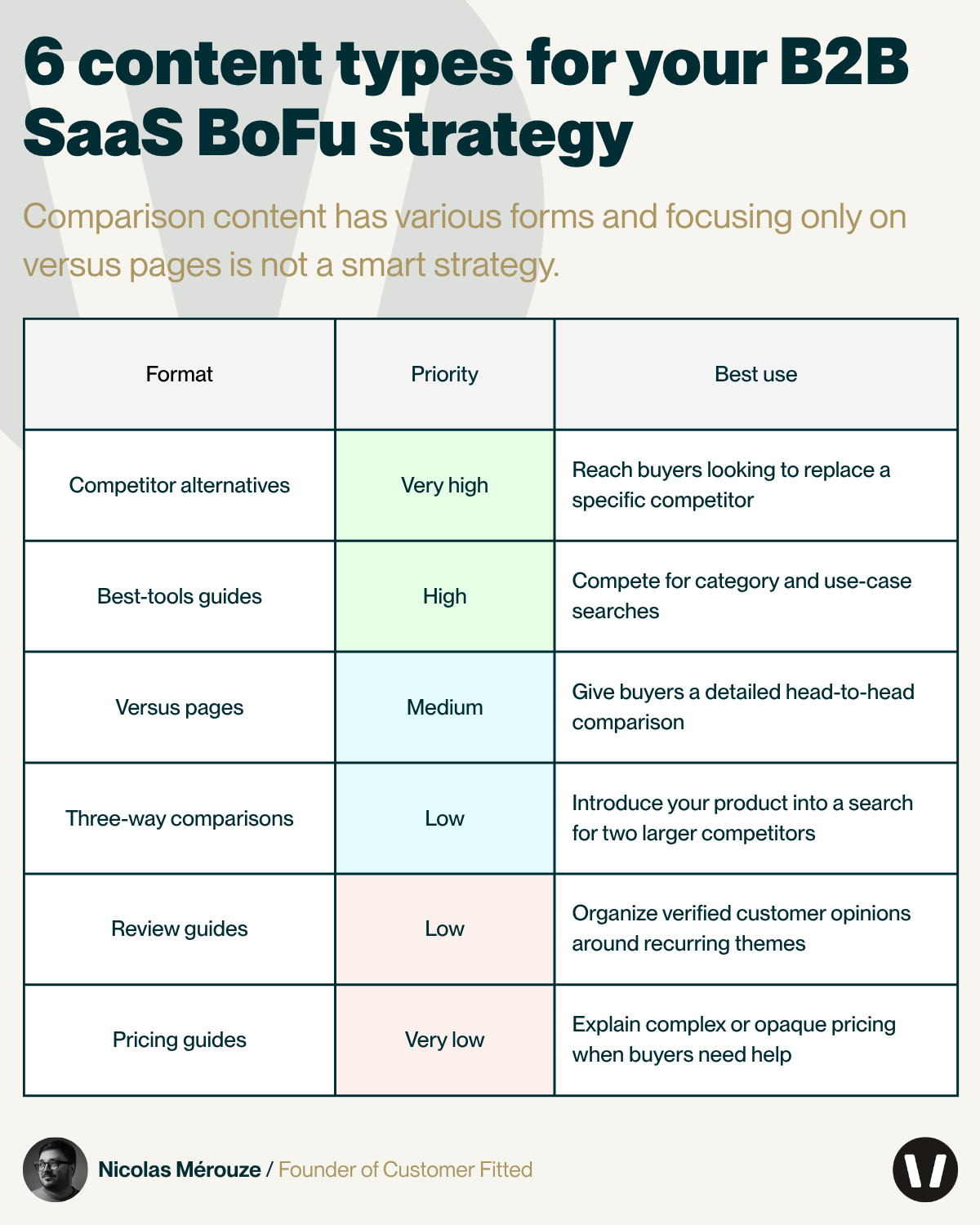
Key takeaways
A connected group of pages gives your brand more chances to appear when an AI system turns one prompt into several searches.
In competitive B2B SaaS categories, I would start with competitor alternatives and best-tools guides before building a large set of versus pages.
Three-way comparisons and review guides are useful in the right category. Third-party pricing guides are usually my lowest priority.
Why my experience differs from the study
Siege Media looked across B2B. I work almost exclusively with B2B SaaS companies in crowded categories where dozens of sites already publish comparison content.
A versus page may send more measurable referral traffic when it gets cited. An alternatives guide can still give your brand more chances to appear across a larger set of searches and influence an answer without earning the final click.
I think both findings can be true. In the categories I monitor, though, alternatives and best-tools pages usually are driving more traffic too.
Query fan-out creates more ways to appear
When someone asks ChatGPT or another AI tool for the best product in a category, they may search the web several times before answering.
For a prompt such as “What are the best X tools?”, it might search for:
best X tools
And then it’s going to shortlist a few brands and follow-up with queries such as:
site:[competitor.com] X features
best X tools [competitor 1] [competitor 2] [competitor 3]
[competitor] pricing
[competitor] reviews
[competitor] alternatives
[competitor 1] vs [competitor 2]
The exact searches change with the prompt and the system. But the pattern stays the same: one broad question can become several narrower searches.
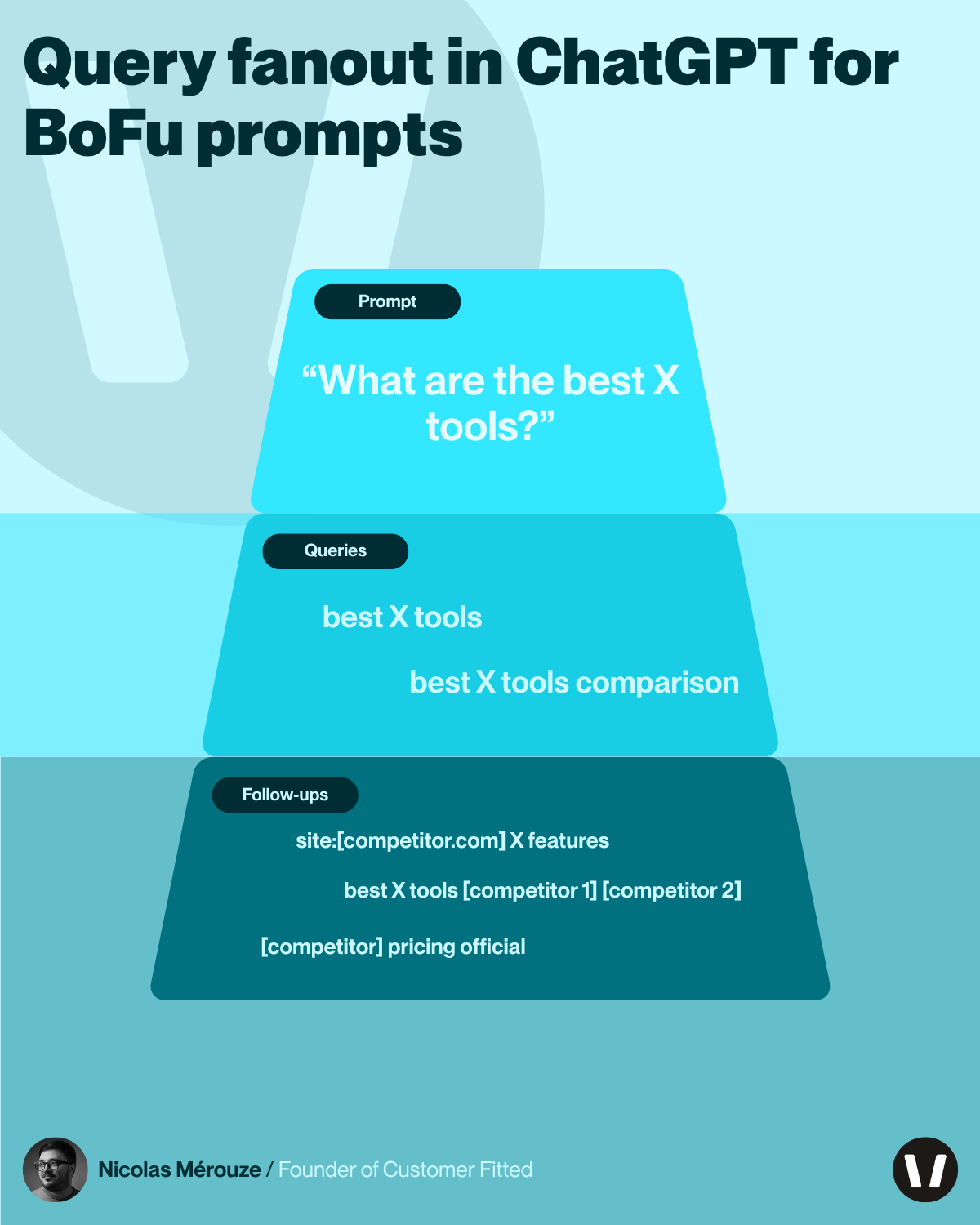
That gives a connected set of comparison pages more opportunities to supply evidence than a handful of isolated versus pages. It is also why I plan comparison content as a group of pages rather than one keyword at a time.
1. Competitor alternatives
If you operate in a competitive category, you may have dozens of credible alternatives guides available. Each competitor creates a separate angle, and each page can address the reasons buyers leave that particular product.
I would not automatically start with the category leader. The obvious “[market leader] alternatives” query is often the most competitive one. Look for established competitors whose alternatives results are weak, outdated, or dominated by generic roundups.
Those pages may have less traffic today. They can still bring as much qualified traffic as a harder keyword where you sit near the bottom of the results. If the competitor grows, you also have a page with history rather than a late entry into the query.
2. Best-tools guides
I put best-tools guides alongside alternatives pages for potential. I rank them second because most products have fewer credible best-tools angles than competitors.
A product with many distinct use cases can support a larger set of guides. A narrow product may have two or three useful angles before the ideas become forced.
You can expand into adjacent use cases, but the further you move from the product’s main job, the weaker the traffic and conversion usually become.
3. Versus pages
I started my bottom-of-funnel content service by producing versus pages. Over time, I have seen them bring less traffic in competitive categories while alternatives pages take over searches that used to surface direct comparisons.
I still make versus pages but their role has changed.
They work best as detailed supporting pages. A broader guide introduces several products, then links readers to the relevant head-to-head comparison when they want more detail. The versus page can cover features, pricing, limitations, ideal customers, and the decision between the two products without forcing all of that into the broader article.
4. Three-way comparisons
This is one of my favorite formats. You compare two larger competitors and add your product as a third option.
Someone searching for “[competitor 1] vs [competitor 2]” already knows the category and is close to making a decision. A useful three-way page lets your product enter that evaluation even when the original search did not mention you.
In a competitive category, you can create 100s of three-way comparisons. Even though they won’t bring much traffic individually, together they can give your product more chances to be visible.
5. Review guides
A review guide collects the recurring opinions buyers have shared about a competitor across public review sites.
The useful version does more than paste quotes into a roundup. It groups reviews by theme, separates common complaints from isolated ones, and shows what type of customer appears to have each experience. Quote people accurately, link to the source, and keep the date of the research visible.
Screenshots adds visual proof. They also make the page easier to scan than a long wall of paraphrased reviews.
Review guides are especially helpful when a competitor’s reputation is an important part of the buying decision. I would not prioritize them in a category where reviews are sparse or say little beyond generic praise.
6. Pricing guides
I have tested third-party pricing guides and seen them mostly ignored by Google and AI systems.
I have also heard of ChatGPT adding words such as “official” when it searches for pricing. That makes sense: the vendor’s own pricing page is the most reliable source, and third-party pricing becomes outdated quickly.
It can still be useful when a market leader has complex, opaque pricing that buyers need help understanding, but it requires frequent maintenance and may never earn much search visibility.
A page or a blog post?
I expect thin pages under 500 words to keep losing ground. Automating a basic comparison is easy now, so publishing another block of text is not much of an advantage.
My next experiment is to turn long comparison guides into designed pages. A custom page gives you more control over tables, navigation, filters, screenshots, and product details than a standard blog template or a Markdown-based publishing workflow.
I think readability will become a bigger source of differentiation as comparison content becomes more automated. For a competent team, research and first-draft copy are becoming solved production problems. Helping a buyer reach the right decision quickly is still a design problem.
The format should not come at the expense of substance though. The page still needs to answer the questions a buyer asks and give AI systems clear facts they can retrieve.
One or two pages will not create much visibility
A single alternatives guide and two or three versus pages rarely cover enough of a competitive category. They leave most use cases, competitors, and buyer questions unanswered.
I would start by mapping your closest competitors and highest-value use cases. Then choose the pages where buyer intent is strong, your product has a credible place in the comparison, and the existing results leave room for something better.
AI makes the production side much faster, but accuracy still needs a system. The agent should research each competitor from current sources, preserve those sources, and leave gaps where information is unavailable. It should never fill a missing price, feature, or customer opinion with a plausible guess.
Once that research is in place, an agent can produce comparison content that needs little editing. The hard parts are deciding what deserves a page, building an honest comparison, and maintaining it when the market changes.
If you want my agency to plan and produce this comparison-content system for you, reply to this email. We can map the opportunities, research the competitors, and build the content that give your product more chances to appear in Google and AI search.
The format matters less than whether each page contains a sentence a model can lift whole and attribute. What gets quoted in my logs is almost always one line carrying a number, a unit, a date and a named source, sitting close to a heading that matches the question. Comparison and alternatives pages win because they naturally produce those sentences, not because of the page type. Write the liftable line first, then build the page around it, and the same six formats do a lot more work.